An unprecedented 10-year-study by the U.S. Fish and Wildlife Service shows encouraging results for frogs and toads on national wildlife refuges.
President Obama has nominated Thomas A. Burke, Ph.D., MPH, of the Johns Hopkins Bloomberg School of Public Health, to fill the vacant assistant administrator position.
A new EIP Report describes TVA coal ash pollutants that were measured over the past five years, including arsenic, boron, and cobalt, exceed health guidelines.
A team of scientists will be leaving for Antarctica this week in order to conduct a pollution study.
Local communities using tools like ropes and sticks produce forest carbon data on par with professional foresters
The U.S. Energy Information Administration (EIA) has released its carbon dioxide report, with information for 2012.
The retailer releases the Sustainable Product Standard, which assesses the safety of beauty products, cleaners and baby care products and aims to force manufacturers to eliminate harmful chemicals used in the products.
A researcher from Texas A&M University has simplified the task of counting shellfish by creating a cellphone app that uses GPS, making tracking over-harvested populations of the species simpler than ever. The app may one day help scientists track other marine life.
The International Energy Agency’s 2013 edition of the Key World Energy Statistics is now available for download. The booklet shows the energy consumption, production, and transformation in more than 140 countries.
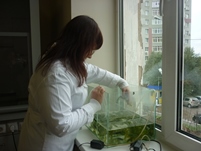
The Samara State Technical University research involves water phytoremediation with the use of Myriophyllum Verticillatum.
- By Alina Kopnina, Olga Zavodskaya
- October 04, 2013
The rufa red knot, a shorebird the size of a robin, has been listed as a threatened species under the Endangered Species Act. The U.S. Fish and Wildlife Service made the announcement on Friday, September 27.
Chemical company Orica, along with the Australian and the New South Wales Governments, will fund the construction of a CO2 mineral carbonation research pilot plant at the University of Newcastle, Australia.
The NREL is partnering up with Ecopetrol, an oil company in Colombia, to use residue from palm oil and sugar cane harvesting to make fuel ethanol for blending with gasoline.
Plant pathologists and mycologists from around the world will gather in Austin, Texas, August 10–14, 2013, for the joint meeting of The American Phytopathological Society (APS) and The Mycological Society of America (MSA).
Scientists from the Agricultural Research Service in multiple locations across the country are participating in the Accelerated Renewable Jet Fuel project to find new ways to create jet fuel from certain invasive trees such as juniper and pine trees.
The 59-40 vote confirmed her as the newest chief of the powerful agency.
To combat and manage invasive species such as fire ants and Cactoblastis moths, the Texas Invasive Species Program has been established at The University of Texas at Austin with a $2.7 million donation from the Lee and Ramona Bass Foundation.
The long-range nesting patterns of loggerhead sea turtles reveal their new habitats and the risks involved.
A new partnership between World Water Works and Aquanos Energy, Ltd. will promote innovative algae-based technology for wastewater purification and renewable energy production.
The Green Parking Council has presented the Pioneer Award to ABB’s Electric Vehicle Charging Infrastructure team due to their work mobility innovation, and has also been honored by the Sustainable Parking Association.