Policies such as the European Renewable Energy Directive are particularly weak when it comes to protecting the environment, reducing greenhouse gas emissions and avoiding human rights violations in developing countries.
One year after the BP Deepwater Horizon oil rig explosion on the Gulf Coast, new research shows that despite the roughly equivalent economic compensation, Louisiana and Florida residents differ in perceptions about the current and long-term effects of the largest marine oil spill in U.S. history.
The Colorado Water Institute has studied what has been working in water transfers and offered some ground rules.

The Ground Water Protection Council and Interstate Oil and Gas Compact Commission unveiled the nation’s first single-source website disclosing additives used in hydraulic fracturing on a well-by-well basis.
A combination of forest byproducts and crustacean shells may be the key to removing radioactive materials from drinking water, researchers from North Carolina State University have found.
Using glycerol from a used cooking oil-to-biodiesel fuel conversion, engineering students developed a soap that is used to clean campus lab equipment and wash hands.

The results of the study suggest the need to develop a new culture-independent, genome-based coliform test to ensure water quality.
Lawmakers have delineated cuts in environmental and energy initiatives across the board in their latest budget proposal.
Dalhousie and McGill university researchers, along with 53 colleagues, studied almost 2,000 coral reef locations to discover that the loss of species can have far-reaching consequences and suggests human population is to blame.
Siemens has launched a new electric-vehicle charging station on the market that can fully recharge a battery within one hour. By doubling the output to 22 kilowatts, the charging station cuts charging times in half.
The draft technical document includes an overview of key concepts, examples of assessments of healthy watershed components, and an integrated assessment framework for identifying healthy watersheds.
The National Research Council urges EPA to improve a draft assessment of the potential health effects associated with formaldehyde exposure.

The new plan should control the Delaware River's salt line and thereby protect aquatic life and drinking water supply that is shared with New Jersey, Delaware, and Pennsylvania.
The University of Maryland Solar Decathlon Team has unveiled its entry in the U.S. Department of Energy competition: a high-tech structure they call WaterShed, because it integrates a unique array of sustainable features designed to protect and make the most of the Chesapeake Bay.
Researcher examined the industry in Pennsylvania, known as the "sweet spot" for natural gas.
The software comes in three editions to support editing/viewing, GIS/mapping professionals, and enterprise-scale users.
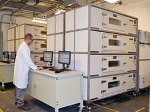
The accredited lab also has been automated to help plastic pipe manufacturers meet regulatory testing requirements with expedited turn-around times.
Kansas State University researchers applied a carbon mass balance and found that the current algae diesel system will not eliminate U.S. dependence on petroleum diesel.
The merging of Stericycle and Healthcare Waste Solutions would reduce competition and increase customer cost, according to the New York attorney general.
The company will produce various products, including an advanced solar backside barrier film, in its ninth facility in China.