No More Refrigerators Ending Up in Landfills?
Last week, my very talented but disheartened colleague Laura Williams wrote a story about how good ideas don’t always change the world. This week, I’ll attempt to buoy her, as well as others, spirits with a story about technology that is making a difference.
Did you know that 9 million refrigerators are disposed of annually? Three fates await them. The metal can be shredded and recycled, they can be refurbished and resold or end up in landfills. The insulating foam, however, is typically shredded and sent to landfills. What’s worse is that the foam contains ozone-depleting refrigerant particles that are released into the atmosphere during the shredding process. Currently there are no legal requirements for foam recovery.
Refrigerators manufactured prior to 1995 used R-12, also known as Freon-12, as a coolant. The Freon-heavy substance is very damaging to the ozone layer when leaked. Models since 1995 use HFC-134a, which has a lower ozone-depletion potential, but still require careful handling during disposal.
Appliance Recycling Centers of America (ARCA), working with GE and Home Depot, has a solution to recover about 95 percent of the insulating foam in refrigerators.
Home Depot will deliver used GE refrigerators from Massachusetts, Connecticut, Pennsylvania, Maryland, Virginia, West Virginia, New Jersey, New York, North Carolina, Delaware, Rhode Island and Vermont to ARCA Advanced Processing’s recycling center in Pennsylvania, where UNTHA recycling technology separates the metal, plastic and de-gassed polyurethane foam insulation. The system automatically captures 98 percent of chlorofluorocarbons, hydro chlorofluorocarbons, hydro fluorocarbons and cyclopentane from the insulating foam. The system can process 150,000 used fridges annually, and that’s just one machine. Imagine if we had a few spread out across the country.
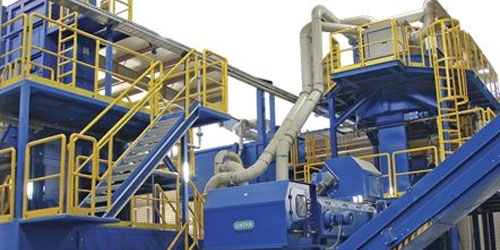
ARCA says that if the foam from the 9 million refrigerators were processed through their recycling technology, the greenhouse gas emissions avoided would be equivalent taking 2.4 million cars off the roads in the United States.
Posted by Sherleen H. Mahoney on September 28, 2011