
Municipalities often tackle stormwater pollution using technology, a system of inspections and enforcement, and routine catch basin upkeep. These methods can abate stormwater pollution, but they do not address the root of the problem: people and businesses, oftentimes unknowingly, engage in polluting behaviors.
- By Tiffany Jonick
- July 15, 2008
Opinion
On April 2, 2008, exactly one year after the landmark U.S. Supreme Court decision in Massachusetts v. EPA, 12 states, supported by an additional five states as amicus curiae, as well as the District of Columbia, the cities of New York and Baltimore, and a number of environmental organizations, filed a petition for mandamus with the U.S. Court of Appeals for the District of Columbia Circuit seeking to compel the U.S. Environmental Protection Agency to act on remand within 60 days.
- By Peter Glaser
- June 30, 2008
Wetlands are complex reactors that facilitate numerous chemical and biological reactions, and these reactions can be exploited to remove pollutants. Today, engineers are able to design wetland systems that can clean up landfill leachate onsite.
- By Mark O. Liner, P.E.
- June 26, 2008
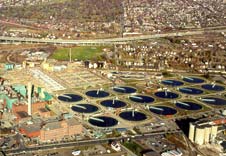
Detroit is known as the Motor City, but water may be its most vital resource. Detroit’s decision in the 1950s to build large water mains in the suburbs and connect them to its water plants pumped the economic and population growth of southeastern Michigan.
- By George Ellenwood
- June 17, 2008

If you're a security integrator working with companies that store or produce chemical or petroleum products, your clients have probably asked for assistance with the Department of Homeland Security's Chemical Facilities Anti-Terrorism standard (CFAS).
- By Matt Scherer
- June 17, 2008

Every time you turn around, you can see technology. Most of it uses electrical energy that creates electromagnetic fields (EMFs), but is this a problem?
- By Gayle Nicoll, Ph.D.
- June 16, 2008
The constant quest for faster, more efficient electronics has created an international waste disposal nightmare because electronic components frequently contain lead, mercury, cadmium, and other toxic materials. The need for responsible electronics stewardship is urgent.
- By Kami Lowery, Sean Story, John Jagelski
- June 13, 2008

Opinion
As record oil prices pinch the wallets of average Americans, the natural gas and oil industry is increasingly asserting that leasing more wild, public lands to natural gas and oil drilling could solve this crisis.
- By Alex Daue
- June 13, 2008

Water professionals will converge on drought-stricken Atlanta for the American Water Works Association's Annual Conference and Exhibition on June 8-12 at the Georgia World Congress Center.
- By L. K. Williams
- June 02, 2008
CB Richard Ellis (CBRE), the global leader in commercial real estate services, manages more than 1.7 billion square feet of buildings around the world. It also has to comply with federal and local rules for ballast, battery, and lamp recycling.
Poor indoor air quality is harmful to building occupants, but in a biotech lab, it can also compromise sensitive research and laboratory experiments.

Officials in Colorado Springs, Colo., had two pressured water mains leaking clean, treated drinking water. One main was a 540-foot section running underneath Fountain Creek and the other was a 500-foot section running under Interstate 25 and two railroad tracks.
It is now three years since Poughkeepsies' Water Treatment Facility in New York installed six Aquionics' ultraviolet disinfection systems for drinking water treatment.

Standby generators lower backup risk
Like many expanding suburbs, Camas, Wash., faced the problem of how to update an aging infrastructure—in particular, its sewage collection system—to meet the needs of the city’s growing population.

On the ocean floor, three miles off the coast of Miami, an underwater city teems with aquatic life and exposes "ruins" from a lost age. A bronze plaque beside a starfish sculpture gives away the fact that while beautiful, this reef is actually artificial.
- By Debbie Bolles
- May 09, 2008

If you work in the electronic, biomedical, pharmaceutical, cosmetic, energy, catalytic, and materials industries and your employer uses nanoparticles or materials that contain nanoparticles, you may be at risk for exposure.
- By Justin Teeguarden, Amit Gupta, Mark Clark, Sr.
- May 08, 2008
Opinion
The pain caused by high oil prices is nothing like what looms as water, an even more basic and essential natural commodity, faces dwindling supplies and growing demand.
- By Sarah Slaughter
- May 01, 2008

Businesses do business for profit. But today, some businesses are stretching their investment because the market is willing to bear the cost for sustainability.
- By L.K. Williams, EPonline
- April 24, 2008
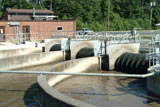
In the early 1990s, Siemens Water Technologies provided the facility with a three-channel Orbal® biological nutrient removal process. In 2004, the plant added a SmartBNR™ control system, a mixed liquor suspended solids (MLSS) recycle pump, and a fourth Orbal channel.