Environmental Protection Blog

Blog archive

Ho-hum: Old Pipes and Wasted Water

How many pipe failures does it take to get your attention?

Yesterday's Van Nuys "geyser" was certainly dramatic (you can watch it online now through several news media Web sites), but did you know that the Los Angeles area experienced 44 main breaks in September and 29 in October and one of them created a sinkhole that swallowed a fire truck?

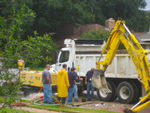
Last Thursday, I was fortunate enough to have a main break in front of my home in the Dallas area. I must say I was intrigued by the repair process:

  • Bring in the trucks and backhoe;
  • Make a hole big enough to put a hose in the street and vacuum out the standing water;
  • Knock on doors to tell neighbors the water would be shut off from about 9:30 a.m. to 2 p.m.;
  • Cut a hole in the street big enough for a man to access the pipe;
  • Make the repair and fill in the hole.

Despite working in the rain, the workers were feeling pretty good about the job until one of them looked up to the street and saw a new river of muddy water bubbling up from a manhole. I heard some profanity, but, they regrouped and ran the routine again.

If too many of these occur, will we eventually consider them everyday happenings and not get excited or angry enough to do something substantial?

By the way, the Los Angeles Department of Water and Power reported that the problem on Sherman Way near Van Nuys Boulevard occurred on an 8-inch connector to a 54-inch ductile iron pipe used to convey recycled water. The 54-inch pipe does not appear to have sustained any damage.

Posted by L.K. Williams, EPonline on Nov 03, 2009 at 12:43 PM


Comments

Wed, Jan 6, 2010 Engineer-at-Risk Arizona

Water pipes break all the time. Pipe break season is in the fall and spring as the temperatures change. The warming and cooling of the water fatigues the metal over time. Water line are under constant pressure and are subject to water-hammer effects. Wastewater pipes rarely break. Other than force mains, they are not pressurized. Because the pipes are large and not under pressure, they are inspected via remote cameras and are cleaned on a regular schedule. This can't be done on water lines in use. Wastewater pipes are subject to corrosion (H2S) and blockages, thus need inspection and maintenance. It is also required by federal law (CMOM). The bottom line is if you see a pipe break in the street, it is most likely a water line, not wastewater.

Wed, Nov 11, 2009 John Herrin Helena, Montana

Wastewater leaks out creating pollution plumes and leaking sewer lines in high groundwater areas also can collect large amounts of water that has to be treated at wastewater plants -- increasing costs. Another major issue is aging drinking water supply lines, Depsite flushing etc efforts, dirt, precipitates and organic matter settle or plug pipes. I have inspected removed old tile city mains and also had to replace my own water line into my house. The old galvanized pipe was rotten and weak, but the real eye opener was the line was nearly plugged with stinking black oosing matter that had over time adhered to the rusted pipe. This happens like plaque build up in human arteries and is a serious concenr for millions of people in the US and even a world wide concern. I know the water in my house tasted bad before I changed out the pipes and I suspect this fetted stinking organic matter in these old pipes was a source of bacterial and other negative health issues on unknowing public. For instance I have read that chlorine in contact with organics creates trihalomethane and other carcenogenic compounds which is compromising the health people believing that there aging public water supply is safe!!! I have heard many say they would rather drink public water than drinking contaminated groundwater, but this maybe a widely accepted truth that is in fact untrue. Is anyone on a national level (e.g. EPA) looking into this major issue??

Tue, Nov 10, 2009 KimberlyV Fort Worth

Municipal utilities are doing their best to address the aging *sewer* infrastructure, where a spill is an actual violation. Breaks in drinking water lines interrupt the utilities' mission - customer service - as well as costs them money in loss of treated water (=$$). New "asset mgt." techniques are inventorying pipes age and condition, and trenchless technologies are used for system rehabilitation. Now, we just all need to be willing to pay water's real costs......

Tue, Nov 10, 2009 George Texas

I don't believe that "water conservation" is the cause. Pipes ought to be designed ot withstand pressures far above peak time. Pressure maintenance is supposed to be one way of reducing leaks. The responder that said aging infrastructure got it right. Accountants say water lines should be depreciated over 80 years. Well, in reality they may last less. Now, it becomes the pubilic officials problem to start replacing on a timely basis.

Thu, Nov 5, 2009 Jon North Carolina

The real reason is the aging infrastructure. Check out the recent History Channel Presentation "The Crumbling of America" http://shop.history.com/detail.php?p=104694

Thu, Nov 5, 2009 Bill Texas

A lot of breaks occur when the temperature of the water being pumped changes by 20 degrees or so. As lake water cools, the temp of the treated water drops and contraction of pipes occurs. Over the years this fatigues the pipe and you have a break.

Tue, Nov 3, 2009 Fred

One theory to the recent rash of line breaks is that water conservation is resulting in added pressure to the lines.

Add your Comment

Your Name:(optional)
Your Email:(optional)
Your Location:(optional)
Comment:
Please type the letters/numbers you see above